
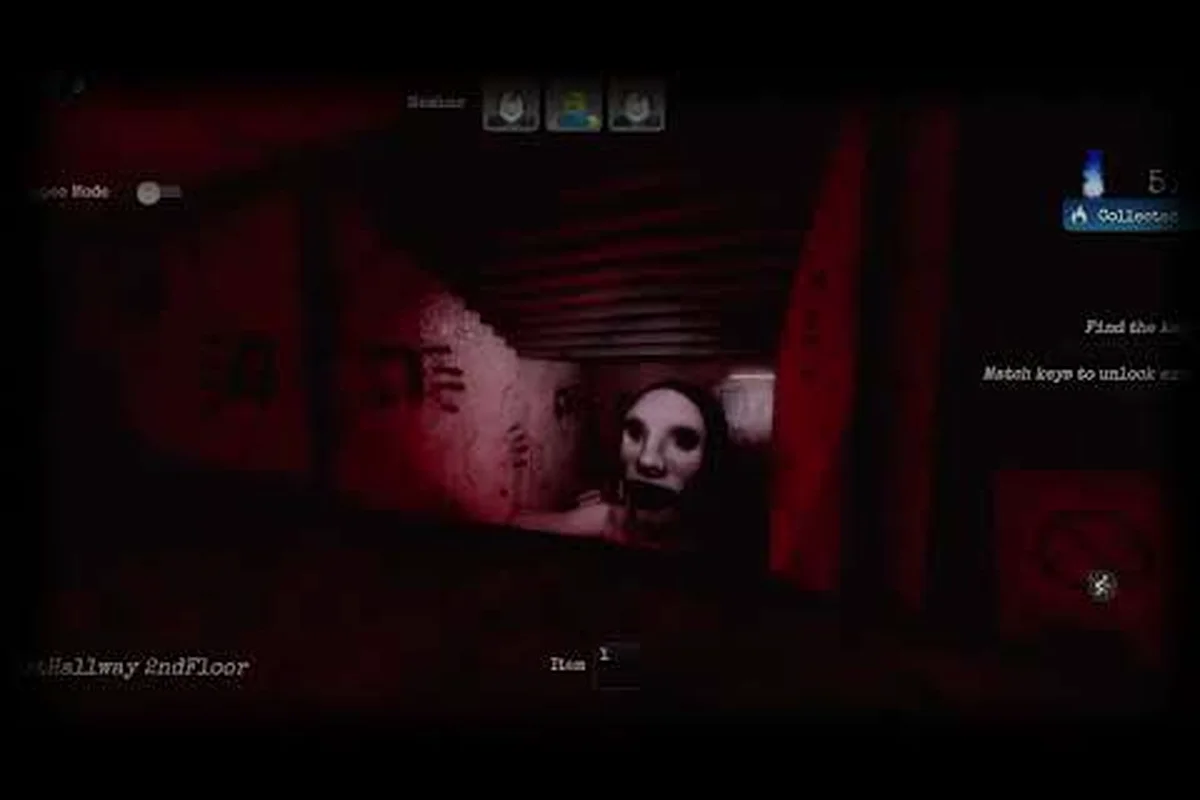
The PETAPETA story looks like a simple chase game on the surface, but the nine levels hide a surprisingly deliberate narrative about memory, guilt, and a world that keeps resetting itself. If you have ever finished a run and wondered what the ending was actually trying to say, this breakdown of the PETAPETA story explained floor by floor is for you.
What PETAPETA is actually about beneath the chase
Most players meet PETAPETA as a first-person horror chase where a grinning creature hunts you through looping corridors. That reading is accurate but incomplete. The PETAPETA lore is built around a single idea: the building you are running through is not a place but a memory loop, and every level is a fragment of someone's past that refuses to stay buried.
According to community reports and the in-game environmental clues, the protagonist is not a random victim. The notes scattered across the early floors suggest a prior relationship with the creature, and the recurring red badge motif points to a shared workplace or school. The chase is the surface layer; the PETAPETA story is about what the runner is trying to avoid remembering.
Three details anchor this interpretation: the level counter resets to 1 after certain deaths, which frames the loop as a deliberate narrative device rather than a standard game-over screen; graffiti and posters shift subtly between runs, suggesting the building itself reacts to how much the runner has pieced together; and the creature's behavior turns from aggressive to almost patient on later floors, reading as recognition rather than pure hostility. Together these clues support the reading that the PETAPETA story is a memory the protagonist keeps re-entering, not a monster they are simply fleeing.
-
The level counter resets to 1 after certain deaths, implying the loop is intentional rather than a game-over screen.
-
Graffiti and posters change subtly between runs, hinting that the environment is reacting to your progress.
-
The creature's behavior shifts from aggressive to almost patient in later floors, which reads as recognition rather than pure hostility.
For readers who want to go further than these three anchors, the theories and endings breakdown catalogs the most popular fan interpretations — the "shared workplace tragedy" reading tied to the red badge, the "guilt loop" reading built on the level counter resets, and the "the creature is the protagonist" reading drawn from its shift to patient behavior — and weighs each one against the in-game environmental clues, noting where the graffiti changes and poster shifts confirm or contradict a given theory. Read it after finishing the base floors, since several entries lean on late-game details.
Why the loop framing matters for the story
Once you accept the loop premise, the PETAPETA lore becomes far more coherent. The creature is not a monster that spawned in a basement; it is a manifestation of something the protagonist did or failed to do. Each floor represents a stage of processing that memory, moving from denial in the early levels to confrontation near the end.
This is also why the game never gives you a clean exposition dump. The PETAPETA story explained through environmental storytelling rather than cutscenes, and that choice is deliberate: you are meant to feel the same confusion the protagonist feels. The discomfort of not knowing is the point.
The nine levels and what each one represents
The level structure is the backbone of the PETAPETA story, and each floor carries a distinct emotional beat — the nine stages are not interchangeable set-dressing but a deliberate sequence in which every environment tells you where the protagonist sits in the denial-to-acceptance arc. The table below maps the commonly accepted reading of each stage based on environmental clues and community analysis, pairing each level's setting feel with its narrative function and the single key clue most often cited as proof: the pristine posters of level 1 against their decayed twins in level 8, the apology note tucked into the maintenance tunnels of level 3, and the broken red badge on the floor of level 6 that ties the collapse directly back to the incident.
| Level | Setting feel | Narrative function | Key clue |
|---|---|---|---|
| 1 | Bright, almost cheerful corridors | False safety / denial | Pristine posters, no damage |
| 2 | Flickering lights, first chase | First intrusion of guilt | Scratched door frames |
| 3 | Narrow maintenance tunnels | Avoidance and hiding | Handwritten apology note |
| 4 | Flooded lower floor | Emotional drowning | Water rising with each loop |
| 5 | Mirrored hallway | Self-confrontation begins | Reflection lags behind you |
| 6 | Collapsed classroom or office | Memory of the incident | Broken red badge on floor |
| 7 | Near-total darkness | Loss of control | Creature moves slower, waits |
| 8 | Reversed layout of level 1 | Inevitability | Same posters, now decayed |
| 9 | Single room, no exit | Acceptance or refusal | Final choice prompt |
The progression from bright to dark and back to a corrupted version of the beginning is not accidental. It mirrors a classic grief cycle, and the PETAPETA lore leans into that structure hard. Level 8 in particular is a direct callback to level 1, and players who notice the reversed layout often describe it as the moment the game "shows its hand."
Levels 1 to 3: building false comfort
The opening floors are designed to lull you. Level 1 has almost no threat, and the environment is clean enough that new players frequently assume the horror has not started yet. That is the trick. The PETAPETA story uses these floors to establish a baseline of normalcy so that the later corruption lands harder.
By level 3, the game introduces the first genuine hiding mechanic, and the apology note found in the tunnels is one of the clearest pieces of narrative evidence in the entire game. It implies the protagonist already knows they did something wrong, even if the player does not yet know what.
Levels 4 to 6: the memory turns hostile
The middle act is where the PETAPETA story stops being ambiguous and starts being confrontational. The flooded floor in level 4 is widely read as a drowning metaphor, and the rising water level across loops reinforces that the memory is getting harder to suppress.
Level 5's mirrored hallway is the pivot point. Community testing has noted that the reflection in the mirror does not perfectly track your movement, which many players interpret as the protagonist's self-image diverging from reality. By level 6, the broken red badge on the floor confirms the workplace or school connection hinted at earlier.
Levels 7 to 9: confrontation and the final choice
The final act strips away the chase mechanics almost entirely. In level 7 the creature slows down and sometimes waits for you, which flips the power dynamic. You are no longer being hunted so much as escorted toward something you have been avoiding.
Level 9 removes the exit entirely. The final room presents a choice, and the PETAPETA lore explained by the community suggests that both options are valid endings rather than one being a "true" path. The game does not tell you which is correct, and that ambiguity is intentional.
How the badges, notes, and posters connect
The collectible storytelling in PETAPETA is dense, and the three main clue types each serve a different purpose: red badges anchor the shared identity between protagonist and creature across Levels 1, 6, 8, and 9, handwritten notes carry the emotional weight of guilt and partial confession, and posters and graffiti track the building's decay as a running loop counter. Understanding what each one is doing narratively — and how reliable it is — makes the whole PETAPETA story easier to follow, since the clues are not interchangeable evidence but three separate channels feeding the same mystery.
| Clue type | Where it appears | What it reveals | Reliability |
|---|---|---|---|
| Red badges | Levels 1, 6, 8, 9 | Shared identity between protagonist and creature | High — appears consistently |
| Handwritten notes | Levels 3, 5, 7 | Guilt, apology, partial confession | Medium — some are contradictory |
| Posters and graffiti | All levels | Environmental state and loop count | High — changes are systematic |
| Audio fragments | Levels 2, 4, 8 | Fragmented dialogue, unclear speaker | Low — heavily distorted |
The badges are the most reliable thread. They appear in the cleanest version of the building and in the most corrupted one, which suggests they are a fixed point in the memory rather than a detail that shifts with the loop. The notes are messier by design; some contradict each other, and players have argued for years about whether that is a clue or just inconsistent writing.
Posters and graffiti function as a loop counter. Players who have compared screenshots across multiple runs report that the decay on the walls increases with each completed cycle, giving you a rough sense of how many times the protagonist has repeated this.
Reading the notes without overreaching
The biggest trap in PETAPETA lore analysis is treating every note as literal truth. Several notes are written in a different hand, and at least one appears to be written by the creature rather than the protagonist. The safest approach is to treat the notes as emotional evidence rather than factual records.
That distinction matters because it changes how you read the ending. If the notes are unreliable, then the final choice is not about picking the "correct" version of events but about deciding what the protagonist is willing to accept. Consider the note written in the creature's hand: read as testimony, it contradicts the protagonist's account outright, but read as emotional evidence, it simply shows the creature mirroring the protagonist's own fear of being forgotten. That reframing shifts the weight of the ending onto the protagonist's internal state rather than an external "true" timeline, which is why lore readings that chase a single canon version keep hitting dead ends. The choice becomes an act of acceptance, not deduction.
The creature's role in the PETAPETA story
The grinning creature is the most discussed element of the PETAPETA lore, and for good reason. Its behavior does not fit a standard horror antagonist pattern, and the shifts in its aggression are one of the strongest narrative signals in the game.
| Level range | Creature behavior | Chase intensity | Interpretation |
|---|---|---|---|
| 1-2 | Distant, rarely seen | Low | Watching, not yet engaging |
| 3-4 | Aggressive, fast | High | Punishing avoidance |
| 5-6 | Erratic, appears in reflections | Medium | Forcing self-confrontation |
| 7-8 | Slower, waits at corners | Low | Guiding rather than hunting |
| 9 | Stationary | None | Awaiting a decision |
The pattern is clear once you lay it out: the creature's aggression is inversely proportional to the protagonist's willingness to confront the memory. When you run and hide, it hunts harder. When you move toward the truth, it calms down.
This reading also explains why the creature never actually kills the protagonist in a permanent way. Death resets the loop, which fits the idea that the memory cannot be escaped, only processed. If you want the full roster of creatures and how they behave across modes, the PETAPETA monster guide covers each one in detail.
Why the creature mirrors the protagonist
The mirrored hallway in level 5 is the strongest evidence that the creature and the protagonist are connected. The reflection lag, the shared badge, and the creature's patience in the final floors all point toward a single conclusion: the monster is a version of the protagonist, or at least a part of them that was left behind.
This is not a novel twist in horror, but PETAPETA executes it with unusual restraint. The game never confirms it outright, and that restraint is what makes the PETAPETA story explained by fans so varied. Some read it as guilt, others as a literal split identity, and a few argue the creature is an entirely separate victim.
What the ending is really saying
The final room in level 9 is where the PETAPETA story stops being ambiguous and asks you to commit. There is no chase, no timer, and no creature attack. Just a choice, and the game's refusal to label either option as correct.
Community consensus, based on multiple playthrough comparisons, is that the endings differ in tone rather than outcome. One path leans toward acceptance and the other toward continued denial, but neither gives you a clean resolution. The building does not collapse, the creature does not vanish, and the loop is not explicitly broken.
That is the point. The PETAPETA lore is not interested in rewarding you with a tidy answer. It is interested in whether you understood what the nine floors were doing. The game modes overview is worth reading after you finish, because the alternate modes reframe some of the same environments and add context to the ending.
The sequel connection
The story does not fully close, and that is deliberate. Later titles in the series, including the School of Nightmares setting, revisit the same themes of institutional memory and shared guilt. The sequel games lore breakdown traces how the badges, the loop motif, and the creature design carry forward into the follow-up entries.
If you have only played the first game, the sequel context changes how you read the level 9 choice. What looks like an open ending in isolation reads more like the first chapter of a longer argument about whether memory can ever be truly resolved.
Practical tips for following the story on your own run
If you want to catch the PETAPETA story details yourself rather than relying on summaries, a few habits make a big difference. The game does not pause for you, so observation has to happen during the chase — and that timing pressure is exactly what makes the loop easy to miss on a first run. Treat each floor as a controlled experiment rather than a survival gauntlet: pick one environmental element (a poster, a mirror, a note) and track only that element for the whole floor, because trying to absorb everything at once is how the key anomalies slip past. The five habits below are ordered roughly by payoff, so if you only adopt two, start with the poster decay pattern and the double-read of notes — those two carry the most story weight per second spent.
-
Screenshot the posters on each floor and compare them between runs; the decay pattern is the clearest loop indicator.
-
Read every note twice — once when you find it and once after finishing the floor, because context changes the meaning.
-
Watch the creature's speed rather than its position; the slowdown in later floors is easy to miss when you are panicking.
-
Check mirrors and reflective surfaces in levels 5 and 8 for the reflection lag.
-
Do not skip the final room dialogue even if you are impatient; it is the only explicit narrative beat in the game.
Players who have done full lore runs report that the fastest way to absorb the story is to deliberately die a few times in the early levels. The reset behavior reveals which environmental details are fixed and which ones change, and that distinction is the foundation of every serious PETAPETA lore theory.
Common misreadings worth avoiding
A few interpretations circulate widely but do not hold up well against the in-game evidence. The most common is that the creature is a separate victim seeking revenge; the badge evidence and the mirrored hallway make that hard to sustain. Another is that the loop is a punishment imposed by an outside force, but nothing in the environment suggests an external authority.
The most defensible reading is also the simplest: the building is a memory, the creature is the part of the protagonist that remembers, and the nine levels are the slow process of admitting what happened. Everything else is interpretation layered on top.
Frequently Asked Questions
What is PETAPETA about in simple terms?
It is a first-person horror chase game where a grinning creature hunts you through nine looping levels. Beneath the chase, the PETAPETA story is about a protagonist processing a buried memory, with each floor representing a stage of denial, confrontation, and eventual acceptance.
Is the PETAPETA lore confirmed by the developers?
Most of it is inferred rather than officially stated. The developers leave the narrative deliberately ambiguous, and the community has built the accepted reading from environmental clues like the red badges, handwritten notes, and the mirrored hallway in level 5. Treat fan consensus as interpretation, not canon.
How many levels are in the PETAPETA story?
There are nine main levels, and each one has a distinct visual and behavioral identity. Level 8 deliberately mirrors level 1 with heavy decay, and level 9 removes the chase entirely in favor of a final choice. The progression from bright to dark and back again is the core structural clue.
Do the endings change the story?
They change the tone rather than the outcome. Neither ending gives a clean resolution, and the building and creature persist in both. Community comparisons suggest the choice reflects whether the protagonist accepts the memory or continues to deny it, which fits the loop framing established from level 1.
Why does the creature get slower in later levels?
Its aggression tracks the protagonist's willingness to confront the memory. When you run and hide in the early floors, it hunts harder; when you move toward the truth in levels 7 and 8, it slows and waits. That inversion is one of the strongest narrative signals in the entire game.
The PETAPETA story rewards players who slow down and read the room rather than sprinting through it. The nine levels form a coherent arc about memory and guilt, the badges and notes supply the evidence, and the creature's shifting behavior tells you where you are in that arc. Once you see the loop for what it is, the chase stops being the scary part.